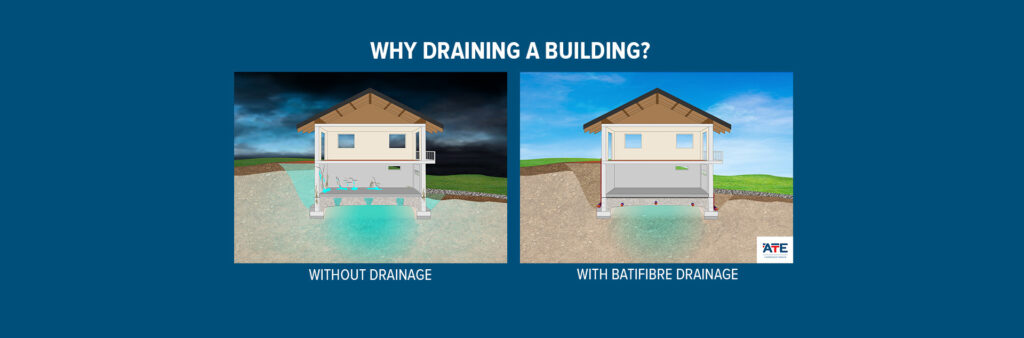

Landscape and civil engineering drainage: Ensure the health of your green spaces and structures by protecting them from excess moisture.
Whether it is to facilitate the growth of plants, lawns or to extend the lifespan of your paved surfaces, drainage is essential in landscaped areas.
ATE, experts in drainage solutions for various applications, guides you through landscape drainage, essential for preventing erosion and flooding, and for maintaining plant health. In the field of public works, proper drainage management helps extend the lifespan of infrastructure.
Whether you are an individual, a professional landscaper or public works (TP) developer, architect or engineer, discover the effective techniques and solutions for optimal water management.
What is landscape drainage?
Landscape drainage involves using techniques and systems to manage and control the flow of rainwater and groundwater in landscaped areas. Effective drainage management is crucial to prevent erosion and flooding problems and to maintain a healthy environment for plants and infrastructure.
In general, landscape drainage involves the use of specific techniques to manage groundwater, including:
- Drainage trenches / Caution, ATE advises against them because the arrival of vegetation and fine particles eventually clogs the system /
- Underground drainage
- Vegetated ditches
Subsurface drainage uses networks of buried pipes to remove excess water away from problem areas. This system is often used in areas where the soil does not allow for effective natural drainage.
The importance of drainage in landscaping and public works
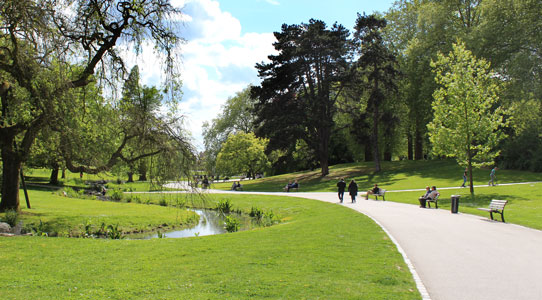
Drainage in gardens, parks and green spaces
Water is essential for healthy plant growth. But if managed improperly, it can cause significant damage to your plants. Before you find yourself dealing with unexpected damage and the associated costs, consider including drainage in your initial plan.
A study of the land and soil quality must be carried out; this will allow for better adaptation of the various essential features to create the ideal garden.
Draining the plot involves regulating soil moisture to prevent the roots of various plants from being suffocated by excess water. Drainage facilitates maintenance operations such as mowing; the ground is usable and access is easy. Walkers will have drier feet. Well-drained soil is more resistant to trampling and frequent foot traffic.
The design of a landscape plan is therefore essential to all landscaping work, carried out according to best practices.
Drainage in infrastructure and public works
The installation of a drain under roads and their shoulders, pedestrian walkways and other structures helps to combat the effects of excess water which degrades structures.
Whether it is installed under a car park, a roundabout, a driveway, a road, or structures built with permeable materials to meet de-sealing requirements, a drain must fulfill two roles:
- Protect the structure from excess water present in the soil beneath it.
- Transporting water that seeps through porous coatings
Effective drainage is therefore crucial; it preserves soil stability in order to prevent the occurrence of structural problems.
- It protects roads and sidewalks by preventing the formation of puddles and cracks caused by water accumulation in the ground.
- It prevents erosion and stops soils from being washed away by runoff water.
- It ensures the longevity of infrastructure by reducing wear and tear due to humidity and stagnant water.
Best practices and maintenance
Managing slopes
The different slopes of your plot must be corrected when carrying out your earthworks and landscaping and must never be directed towards the structures, the water being intended to be absorbed by the soil and plants and the excess runoff water must be redirected to swales or gutters, then stored to be infiltrated or reused.
Topography will also be taken into account for the installation of public works infrastructure; a slope must be maintained to promote the flow of surface water and also redirect it towards storage or infiltration.
Regular inspection
It is important to regularly check installed drainage systems to detect any blockages or damage.
Solutions for efficient landscape and civil engineering drainage
Drainage is essential for controlling water in the soil and preserving the aesthetics and longevity of your landscaping.
In France, in 80% of cases, professionals and individuals use conventional drainage with geotextile and gravel for green spaces and gardens, in order to ensure the 3 key functions of good drainage:
- Filter the water while reducing the risk of clogging
- Collect and distribute excess water to prevent stagnation.
- Protect the drain from mechanical compression and impacts to ensure the longevity of the installation.
A common mistake is to try to collect runoff water, thinking that the gravel around the drain can act as a catchment (funnel). Runoff water flows too quickly and in too large a quantity to be absorbed by a drain, which is not its purpose: a drain regulates the moisture already present in the soil.
The water that is being channeled through gravel beds to the drains is laden with fine particles (dust) and vegetation, which clogs the gravel very quickly. Runoff must be managed at the surface (gutters, swales, ditches, etc.).
Drainage using geotextiles on gravel, while not very effective, is often difficult to implement and has a poor environmental impact. The transport of gravel and the extraction of aggregates have a significant ecological footprint.
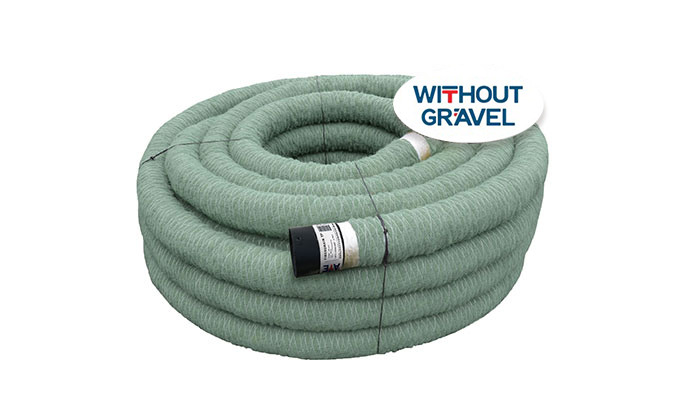
ATE designed the FIBERDRAIN TP drain for plots to meet all these challenges: efficiency and durability of the installation, reduction of the arduousness of implementation and reduction of the carbon footprint.
The characteristics of the FIBERDRAIN TP gravel-free drain
- The FIBERDRAIN TP system is designed to completely eliminate the need for gravel.
- Installing FIBERDRAIN TP is simple and requires no special expertise. It can be installed by DIY enthusiasts or amateurs, provided they adhere to the basic requirement of creating a straight slope on the drain.
- FIBERDRAIN TP with its high drainage capacity is able to efficiently manage large quantities of water, thus helping to prevent flooding of plots.
The various applications of FIBERDRAIN TP :
LANDSCAPE DRAINAGE: Private and public gardens, Parks, Small plots, Forests, Vineyards, Nurseries and market gardens
Under-slab drainage: Concrete slab outside the building, Septic tank, Micro-treatment plant, Swimming pool, Retention basin
UNDER-ROAD DRAINAGE: Under the asphalt road (implementation must comply with booklet 70), Ditch, Roundabout, Under car park, Under sidewalk, Under compacted road surface

By using these techniques, landscape drainage and civil engineering not only helps to protect plants and infrastructure, but it also contributes to sustainable water management, preventing flooding and reducing the environmental impact of runoff water.