

Wastewater management by spreading on the plot
Homes not connected to a public sewer system must be equipped with an individual wastewater treatment system, known as a ” non-collective sanitation system ” (ANC), to treat their wastewater. This is a legal requirement that all property owners must comply with. To ensure compliance, the system must be properly designed, installed, and maintained.
Wastewater spreading solutions
The existing soil is used as a purification system during the implementation of your sanitation (wastewater treatment) and as a dispersing medium (evacuation).
For the selection of materials, refer to the recommendations of DTU 64.1 P1-2 for the choice of geotextiles, pipes, conduits, etc. Aggregates (sand and gravel). The gravel must be washed, water-stable, and have a particle size between 10 and 40 millimeters. Sand intended for wastewater treatment has a particle size distribution curve that falls within the range specified in NF DTU 64.1. Washed siliceous rounded sand (particularly from alluvial deposits) is the most suitable. Sand from limestone quarries is prohibited.
If the soil permeability is too high, a reconstituted bed is installed. Washed sand is used as a support for purification (treatment) and the existing soil as a dispersing medium (removal).
The implementation of your collective wastewater treatment system using spreading
The spreading plan is carried out after a thorough soil study in order to determine the most suitable location and system, which will be controlled by the SPANC.
This plan must meet specific criteria. The bed or spreading trenches must therefore:
- The trenches must be located 5 meters from the building and 3 meters from the property line, on a plot of land of at least 200 m².
- Keep at least 3 meters away from plants with roots (trees)
- Located 35 meters from a water source and 1.5 meters from a water table
It is advisable to use a specialist and approved company to install the appropriate system.
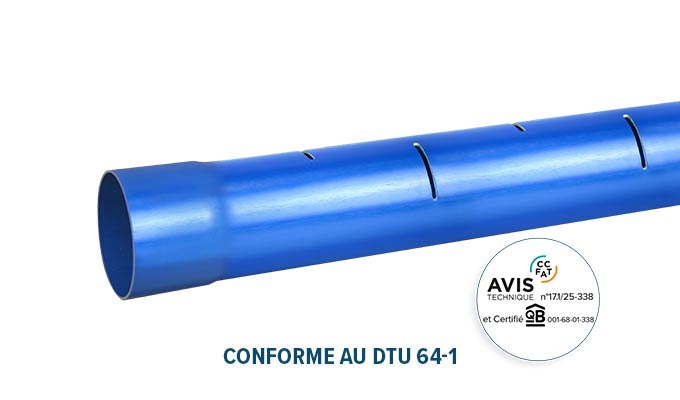
ATE has developed a resistant and easy-to-install tube, whose perforation surface allows optimum spreading, the Batipand SN4 PVC spreading tube to resist corrosion, under Technical Approval 17.1/25-338, certified QB -68-01-338 and compliant with the requirements of DTU 64.1.