Golf course drainage is a fundamental part of course management and maintenance. It affects not only the appearance of greens and fairways, but also playability, turf health and the longevity of the entire sports ground. Controlling water, whether from natural precipitation or irrigation, is a major challenge for golf course maintenance managers, agronomists and landscape architects.
Context: why drain a golf course?
A golf course consists of large areas of very fine grass (greens, fairways, tees, roughs, etc.), often laid on a variety of soils (clay, sand, silt). Their exposure to the elements and climatic variations makes optimal water management essential.
Waterlogged soil becomes slow, sticky, uneven and sometimes impracticable. Stagnant water promotes turf diseases, root asphyxia and areas of decline.

Proper drainage of golf courses and sports fields preserves the quality of the infrastructure and prevents deterioration of the terrain. It preserves playability, ensures the health of the turf, optimises maintenance operations and limits runoff and erosion.
In short, proper drainage of a golf course guarantees an optimal experience for players, greater productivity for technical teams and increased sustainability of the site.
“Essential on greens, drainage can also be installed on fairways, tees and bunkers. This crucial element must be taken very seriously (especially on clay soils) in order to improve playability in wet conditions. If drainage is not planned initially, it can cause health problems for the future operator due to poor water drainage/infiltration…”
Ref: French Golf Federation in its guide ‘Building a golf course’
Basic rules for effective golf course drainage
Designing and installing drainage for a golf course is a complex operation. An effective drainage system must be designed according to several essential principles:
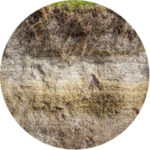
Agronomic soil assessment
Before any work is carried out, a soil study is essential: particle size, permeability, clay content, pH, groundwater level, etc. These parameters determine the choice of drainage techniques and materials.
A golf course may have several different types of soil, each with a different absorption capacity, which requires precise adjustment of the systems.
2. Drainage design adapted to the golf course terrain
Every golf course has low-lying areas, slopes, areas where the slope breaks or where water can potentially stagnate. Drainage must take into account:
- Areas sensitive to water (low-lying areas, edges of water hazards)
- Natural flow paths
- Areas of high traffic and strategic play

3. Hydraulic standards
Hydraulic calculations are performed to size the networks: expected flow, precipitation frequency, temporary storage capacity, flow velocity, etc. The goal is to prevent overflow and saturation, as precipitation can vary greatly from one season to the next.
4. Maintenance and accessibility
A drainage network must be accessible for inspection, cleaning and possible replacement, especially after rainy seasons or harsh winters.
A poorly designed system can become clogged, collapse or deteriorate over time, resulting in high maintenance costs.
Drainage techniques used on golf courses
Depending on the topography and constraints of the site, different techniques can be used to drain golf courses:
- For large areas or very wet areas, denser or grid-like networks allow drainage through drainage tunnel systems.
- Low points are often equipped with retention basins or infiltration areas that delay the drainage of water into the storm sewer system or groundwater.
- Specially designed substrate layers (draining sand, filtering materials) promote the flow of water towards the drains.
- The most common drainage system is an underground network of perforated drains laid in trenches filled with gravel and/or geotextile. They capture excess water in the soil and convey it to collectors or basins. They are particularly effective on fairways and tees, but are complex to install.
FLATTEX: a technical and sustainable solution for golf course drainage

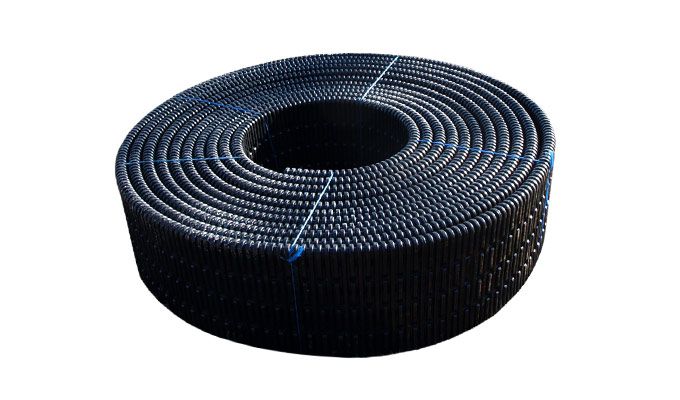
Given the challenges and complexity of golf course drainage systems, FLATDRAIN and FLATTEX are the high-performance, reliable drainage solutions that are tailored to the specific needs of golf courses.

ATE has designed and developed FLATDRAIN, the flattest high-density polyethylene (HDPE) drain on the market, which is suitable for golf courses (greens and fairways) as well as large playing fields (football, rugby, etc.), equestrian grounds (quarries, racecourses) and civil engineering (renovation in confined or difficult-to-access spaces).

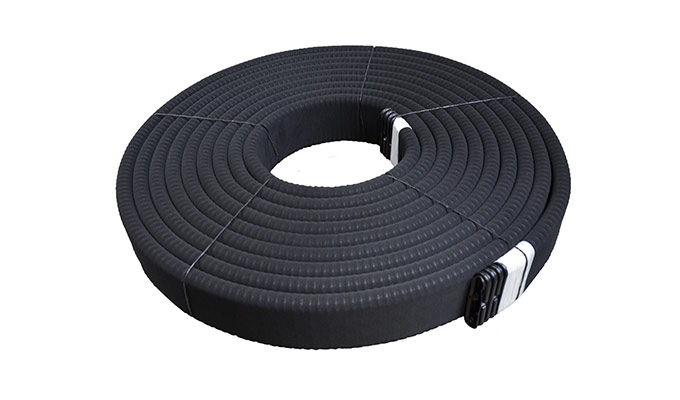
ATE has also developed FLATTEX, a flat drain encased in a special filter sleeve with a large open area to meet different soil constraints.
Why is FLATTEX a high-quality solution?
Thanks to its unique structure, FLATTEX facilitates rapid drainage of excess water, reducing the risk of saturation and stagnation.
- Its drainage performance is superior to that of a corrugated cylindrical pipe, allowing for greater flow.
- Its high mechanical resistance (SN25) enables it to withstand compression, even at shallow depths. FLATTEX optimises drainage without compromising soil quality and can be integrated into sustainable water resource management initiatives.
- Its thin profile (4 cm) and width (17 cm) give it high three-dimensional stability.
- Lightweight and modular, this solution offers a significant advantage in complex installations and renovation work, facilitating installation and maintenance.
- It can be laid flat or upright depending on the complexity of the site.


- This flat drain is equipped with a 450-micron fabric that prevents clogging.

Whether for greens, fairways, sand bunkers or sensitive areas, FLATTEX adapts to the terrain and the specific topographical and hydraulic constraints of each golf course. In addition, a well-designed golf course drainage system will generate lower maintenance and renovation costs in the long run.
Golf course drainage is therefore a key technical factor in ensuring performance, durability and playing comfort. It is based on a precise analysis of the soil, an appropriate hydraulic design and robust technical solutions. In this context, FLATTEX is a reliable and effective option, capable of meeting the water challenges specific to golf courses, for healthier, more sustainable and more enjoyable courses.
Whether you are an architect or project manager, or if your profession is related to the construction and operation of golf facilities (planners, design offices, urban planners, consultants and agricultural engineers, irrigation and drainage experts, landscape architects, construction companies with expertise in golf), ATE is at your disposal to provide you with further information.